East Asia’s growth miracle was the recurring theme of my university studies a decade ago. Japan took up a large chunk of that, being the first country to ever catch up with the early industrialisers in the twentieth century, an accomplishment only matched by South Korea and Taiwan since.
The topic stuck particularly well with me perhaps because I’m German: one of my professors used to show us pictures of Bismarck and Meiji-era military dignitaries and politicians in quick succession so we would subliminally understand the deep political and economic resemblances between the two countries.
My professor at Master’s level had us study German economist Friedrich List to fully appreciate Japanese policy after WWII, especially with regard to the infamous “infant industry protection” strategy. After all, who remembers that Toyota sold a mere 287 Toyopet Crown sedans in the US the first time it tried in 1958?
***
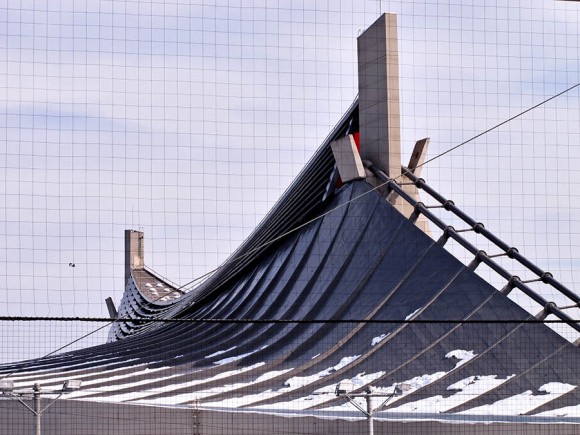
A two-minute stroll away from my temporary home in Tokyo is the Hotel Okura, built to house guests for the Olympic Games in 1964. It was also the venue for the IMF/World Bank meetings in September that year (like it was again in part last year, in 2012).

At first we stumbled into the lobby of the South Wing by chance. It looks pretty and dignified, reminding me a little of East German architecture from that time. Reading more about the Okura back home, I felt Japan’s post-WWII economic growth was coming back to life here, right outside my house.
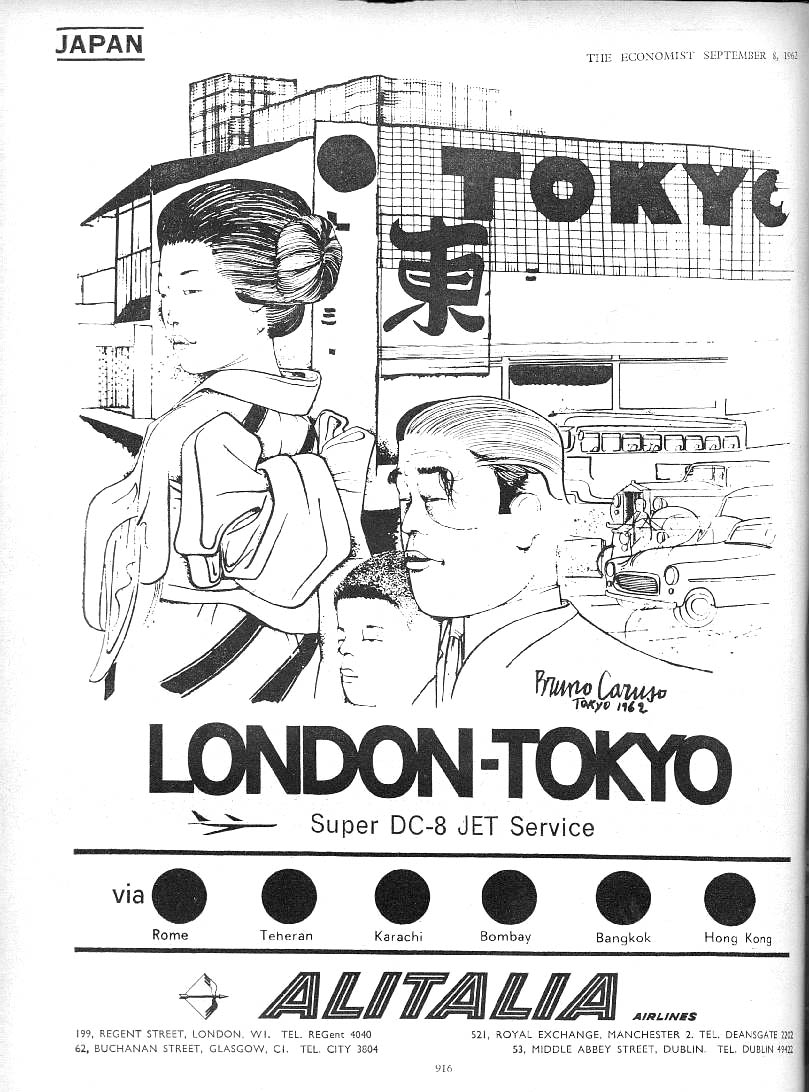
Although the “miracle” was already in full swing and industrial production skyrocketing as of the early sixties, the world was only slowly waking up to Japan’s revolution. No wonder, as it was almost entirely related to domestic growth until then. In fact, Japan secured further loans from the World Bank to develop its domestic bulllet train (Shinkansen) network at the 1964 meetings.
A few blocks down the road from the Hotel Okura is the Kasumigaseki Building – Japan’s first skyscraper that opened its doors in 1968. Before that, strict regulations prohibited tall buildings due to the ever-present danger of earthquakes. Tokyo’s skyline was correspondingly low-rise. The Asian Development Bank, the Japan-led regional development bank, has its national headquarters here to this day.
Big corporations such as the flag carrier ANA also opened their main offices in this prestigious new building that now looks a little nondescript among its many high-rise peers in the area. Yet back then, it symbolised a new-found confidence: Japan had made it back to the world stage as a respected peer. This notion, perhaps first aired during the Olympics in 1964, became stronger with each new skyscraper dotting the quickly changing skyline of the city.
Perhaps unlike any other, the Kasumigaseki Building represents the transformation of Japan’s post-WWII economic policy from an inward-looking model to the much-revered and copied export-led growth: the dawn of the Japanese Century was upon the world.

People in the first world understood quickly that Japan was catching up with them and overtook many in the process. Evidence of that began to appear in their everyday lives, above all in the United States: from transistor radios to the all-time bestselling car Toyota Corolla (incidentally launched in the US in 1968) – all came made in Japan.
These two buildings got me thinking – if they succeed in bringing to life this most remarkable phase of history, could there be others, too? I went out venturing by foot to find more, and did so very close to my home again.
***
The Reiyukai Temple looks like a spaceship that has landed in downtown Tokyo. Yet it is place of worship, built in 1975 by the Reiyukai sect of Nichiren Buddhism, a strand of Buddhism very popular in post-WWII Japan. Its main hall seats more than 3,000 people, and the building’s dimensions as well as building materials give it an eerie air.

Japan’s new religions are fascinating. It is impossible to look at their meteoric rise after WWII without considering the context of rapid economic growth and urbanisation. A growing urban middle class was very susceptible to the notions of community and spiritual health these groups were promulgating.
After all, the boom’s darker sides began to estrange people: often inhumane working conditions, ubiquitous pollution and an increasing atomisation of society were only some of the frictions that became all too evident.
Yet these groups were growing fast also because of tax breaks and constitutional freedoms granted to them by the Allies’ administration between 1945-1951. Buildings such as the Reiyukai Temple and the Rissho Kosei Kai headquarters thus became a monument of the fact that these religious groups had now “arrived” and intended to stay on as a very important part of Japan’s spiritual landscape.
This manifestation in Tokyo’s urban landscape is most striking when one appreciates that many of these groups faced severe repression before the war.
***
When I started this blog I posted some photos of the Nagakin Capsule Tower in Ginza, perhaps sparking off my interest in architecture from the 1945-1975 period. The enigmatic building was designed by Kisho Kurokawa, an important architect who co-founded the seminal Metabolism group.
Unlike any other Japanese architects, the Metabolists tried to find answers to the most pressing concerns of their times: seemingly uncontrolled urbanisation, environmental degradation and the ubiquitous fear of another “Big One” – a cataclysmic earthquake shaking the Tokyo region as the Great Kanto Earthquake did in 1923.

Beyond this rather dark vision of the Japanese capital propagated by the architects, Tokyo’s growth as a city post-WWII also offers positive lessons. Perhaps paradoxically, a lack of city master planning was the key to its organic growth that would eventually see 36 million people live here, making it the largest metropolitan area on earth today.
Architects coped with the challenges of urbanisation in manifold ways. Takamitsu Azuma, for example, bucked the trend of young families moving to the outskirts and decided to stick it out in the middle of the city, on a tiny leftover land plot. His Tower House is a beautiful monument for his determination to realise one’s ambition even if space is very limited – something that perhaps holds true for Tokyo as a whole.

***
Thinking about these buildings within the context of Japan’s post-WWII history has crystallised into an idea for an e-book. I would like to create a reader on the topics above (and perhaps more). I feel that there is the need for such a travel companion for visitors and tourists to Japan, real and digital, be they on foot in Tokyo or sitting in the comfort of their armchair.
The book will bridge the world of architectural guides to Tokyo (of which two excellent ones were written by Ulf Meyer and Hiroshi Watanabe respectively) with that of historical books about Japan. I imagine it to navigate its reader through the country’s miracle years with the help of some often awe-inspiring landmarks in downtown Tokyo.
For many Europeans, architecture is the ultimate container of history. Japan functions somewhat differently, inasmuch as a constant scrap and build process is equally about preservation as it is about destruction. Nowhere is this better visible than in the Ise Shrine, scheduled for dismantlement and rebuilding every 20 years.
So in a not-so-distant future, some of the 10-15 houses highlighted in this book will have fallen victim to the wrecking ball. Perhaps it is also for them that this book should exist.
I am no acclaimed expert on either of the three topics I have outlined above. However, I feel that my academic and other experience in development economics as well as my research skills are solid enough to produce a few thousand interesting words on the economic miracle. The book is intended for a non-specialist but interested audience.
For the other topics, I will ask experts to lend their authority and shed light on the context the buildings were built in. They will then be introduced at fitting stages of the narratives, in detailed sections featuring maps and photographs.
Work will probably take the better part of the next three months. If you want to contribute to this project in any form whatsoever, comment on this post in private or just ask a question, please don’t hesitate to get in touch with me at hello at benbansal dot me.
Thanks for reading!