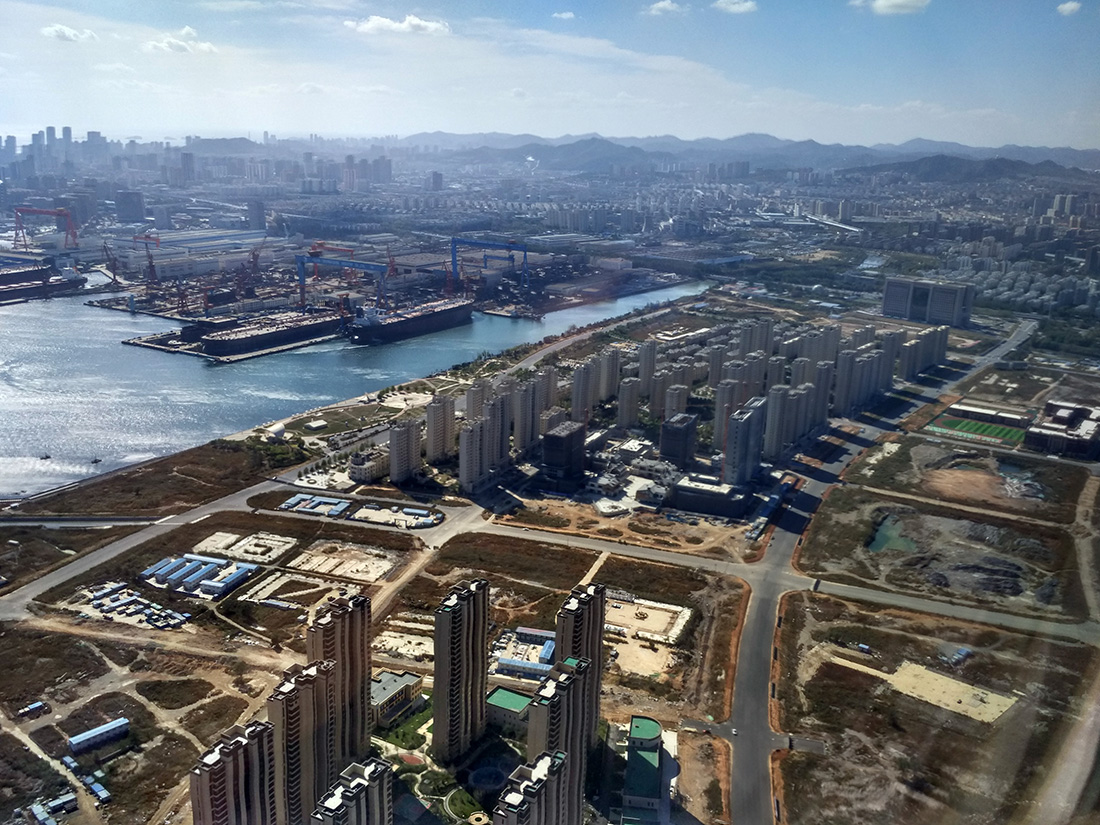
For lack of a better picture, this is Dalian in China as seen from the air in late 2017
The UN’s Population Division published the 2025 update to its flagship World Urbanization Prospects a few weeks back. Its 2014 and 2018 revisions provided some of the statistical backbone of my PhD’s introduction, so I thought it’s worth looking at the urban state of affairs almost 10 years later.
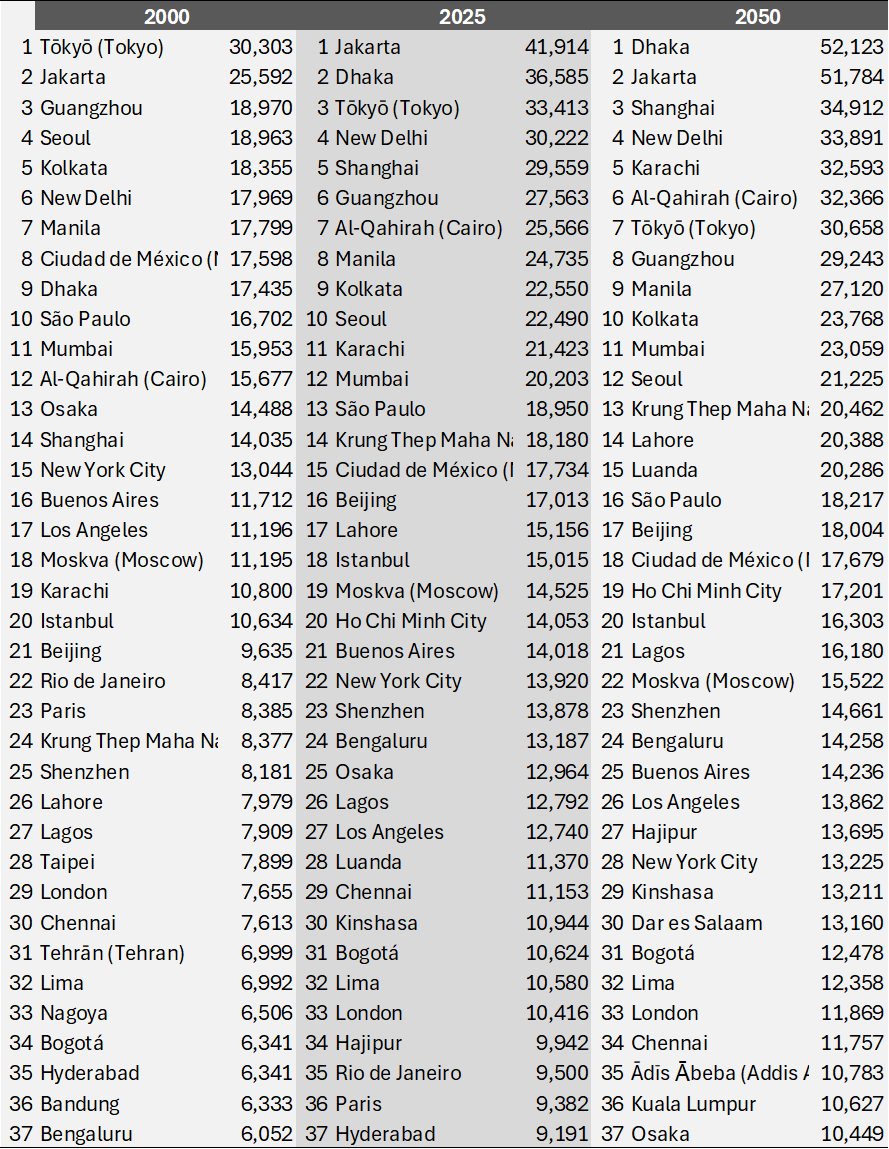
The most important message–for me personally at least–is that Tokyo, with its 33 million inhabitants, now longer occupies the top spot of the list of the world’s largest urban agglomerations, which it had done until the latest report.
Instead, this accolade now goes to Jakarta (42 million inhabitants), followed by Dhaka (37 million). The change in the list is due to an updated methodology using consistent geospatial data. In fact, the report makes a retroactive adjustment, timing the moment of Tokyo passing the baton to Jakarta some time between 2005 and 2010.
There are some other significant changes to the outlook.
One city that caught my eye immediately is Lagos. I remember the press coverage when research suggested it’d be the first city to cross the 100 million inhabitant mark by 2100. In the 2018 edition, it was forecast to hit 24.4 million inhabitants by 2035. The latest figures put Lagos at 16.2 million in 2050, quite a significant downward adjustment.
However, the overarching theme of rapid African urbanization remains unchanged. Incidentally, it is Egypt’s Cairo that remains the largest African and only top-ten global city. The largest sub-Saharan agglomeration, Luanda, comes in on 28th spot in 2025 and 15th in 2050, both times ahead of Lagos and Kinshasa.
At the same time, the Asian dominance of megacities (admittedly a fairly optical benchmark) appears to have peaked, with 60% of all 10+ million cities Asian in 2000, 57.6% in 2025 and 56.8% in 2050. This is about in line with the proportion of Asia’s population in world population.
At an even more macro level, the world’s urbanization rate has now three components in the WUP, i.e., population living in cities, towns, and rural population. With this we can leave the binary of urban vs. rural behind, and capture the more complex reality of our habitat, e.g., peri-urban areas outside of larger cities.
In 2025, 45% of the world’s population lived in cities (now with a lowered threshold of 50,000 people and a density of at least 1,500 ppl/km2), 36% in towns (5,000+ people and 300 ppl/km2), and 19% in rural areas. The estimate of the world’s urbanization rate remains largely unchanged at 58% in 2025.
I put some figures in the following table (37 cities = 37 megacities by 2050), showing the changing and growing guard of megacities, all drawn from the most recent dataset.
I wrote a short piece for The Metropole (the blog of the Urban History Association) a few years back in which I dwelled on the history of megacities and on what other megacities can learn from Tokyo. In fact, many of them have undergone, or are undergoing, their “Tokyo Moment”, i.e., at least doubling their already large population in a period of 20 years. This brings with it significant challenges of scale, necessitating unique governance models.
Looking elsewhere for inspiration is not just a question of geographical focus or looking for cities with similar population figures, but also one of selecting the right historical time frame.

