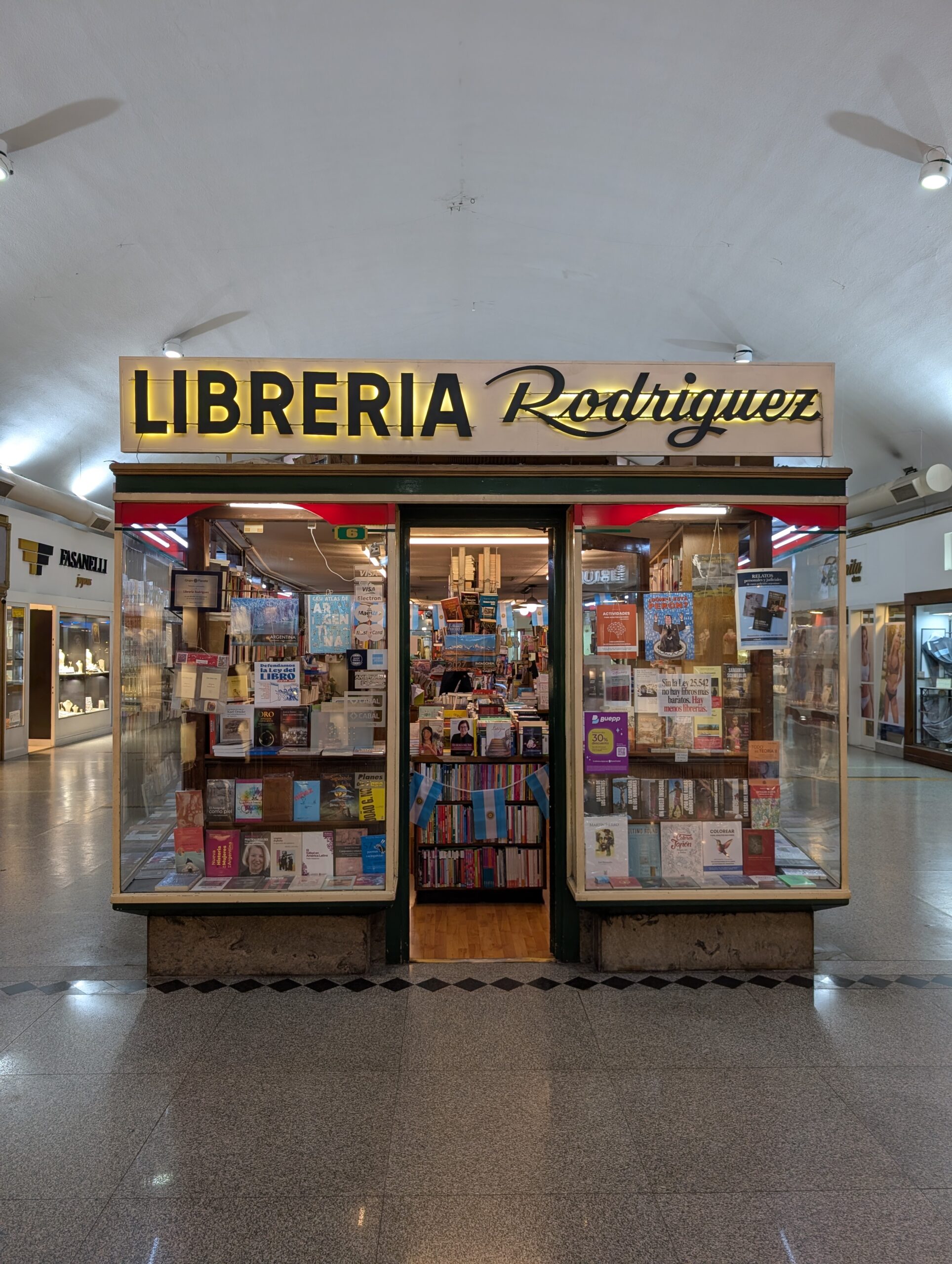
Speaking of bookshops further below, this beautiful Libreria Rodriguez caught my eye on a stroll along Av. Cabildo in Belgrano
We moved to Argentina one month ago, and it’s high time to record the moment on this blog. Buenos Aires is our new home, and we’re excited. This city is a beast, beastlier now than I remember it from more than ten years ago when I didn’t have any kids and visited last.
I am planning to pen down my observations of life here and reactivate the blog a little with these daily life posts. It was fun browsing through the archives and seeing what I had time for back when visiting the place in 2009 and 2014. Notably, we visited a lot of museums and I had a chance to perceive the architectural gems this place has to offer a lot more.
One of the things I plan to do in the coming years is to (re)engage with economics. Argentina is a great place which works according to its own rules, but has a lot to contribute to the field’s debates beyond the Latin American country, and the continent as a whole. I was particularly intrigued by a recent blog post on Naked Keynesianism, which served as a great introduction to the economic record of the incumbent Milei government.
The post pits the author’s heterodox leanings against someone who has moved from the mainstream towards his position on the macro front, but remains a staunch proponent of rather neoclassical/institutionalist explanations for the microeconomic balance of Milei’s government. I had to think of the class on economic development I taught at Temple, the reading for which included Mushtaq Khan’s critique of the focus on corruption in the reading for an undergraduate cohort.
As the Argentine government dismantles what little there was left of a functioning industrial policy, the question in 2026 remains: What is a suitable development strategy for a peripheral country like Argentina? Is the literature exhausted? Is the experience of the East Asian Tigers and Southeast Asian Flying Geese still instructive in this day and age of (post-)manufacturing? Or is Argentina’s seemingly deliberate and intentional self-degradation to a classical Third World supplier of raw materials with a free reign for foreign capital the only realistic way to go?
An exceptional introduction to the current political situation was “Freiheit fuer Wen? Mileis Argentinien als Versuchslabor der Ultrarechten” (“Freedom for Whom? Milei’s Argentina as an Experimental Laboratory for the Extreme Right”) by German journalist Frederic Schnatterer. This came out in April 2026, so is quite up to date. My dad gave it to me before we left Germany, and I read it in a couple of sittings despite the tiredness and distraction related to moving to a new place.
The picture is quite grim. The libertarian economic agenda of Milei finds allies in the most repressive elements of Argentine society. Putting their narrow-minded “economic liberty” at the heart of their rather thin ideology translates into political repression and inhumane austerity and state retrenchment. This is a playbook now being adapted worldwide, but here we can see it put into practice with almost satirical purity. It’s not funny though, and the world should look more closely rather than rely on stylized factoids.
I had thought about opening a bookshop in the next location we’ll move to. Argentina presents a set of challenges to that mission, but also uniquely rich intellectual pastures. Buenos Aires is the city of bookshops. The questions above and many others that are burning today, and yearn to be discussed in person, with real people, are not going to be answered in solitude or in conversations with a chatbot.

