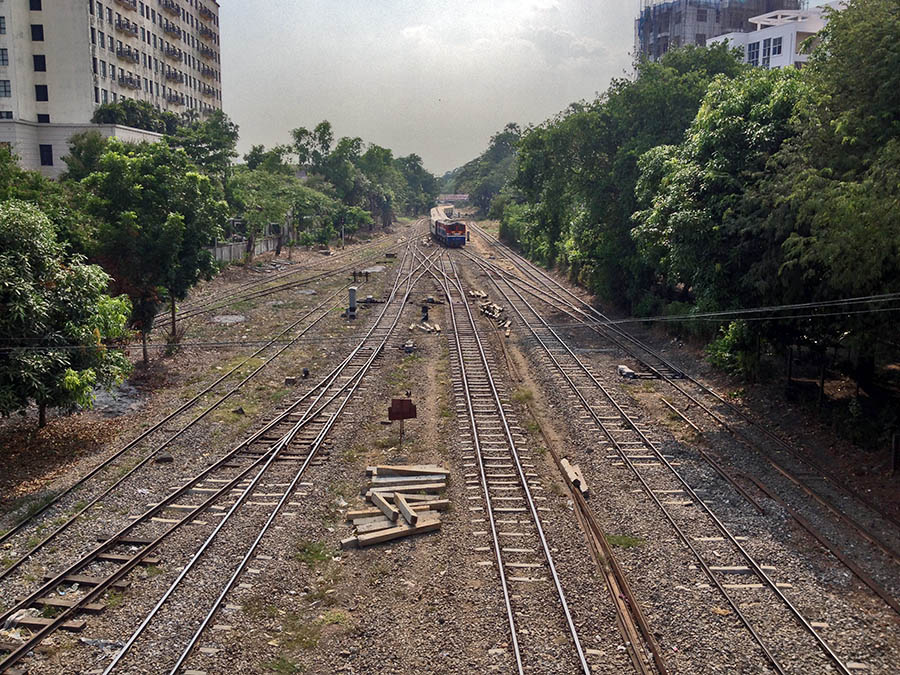
A photo taken sometime in 2013 from the railway bridge near Yangon’s Central Railway Station
I came to Burma/Myanmar for the first time in 2013 on an assignment to scrutinize the country’s “opening up” from a foreign investor viewpoint. Over the next six years, I returned on several occasions, primarily to learn more about the built environment of its former capital Yangon. The cityscape was a mirror of the rapid development the country was now undergoing: Everywhere were cranes and bulldozers, growing traffic was choking the busy downtown area, an air of change and optimism was palpable. Some colonial-era heritage buildings were becoming speculative assets, some were still forlorn and grown over by trees and bushes behind high but porous fences, while some were torn down to make space for new buildings. The growing political role of Aung San Suu Kyi’s NLD made the incumbent civilian-military leaders increasingly nervous, and a coup restored the junta to power in 2021. Since then, Myanmar is locked in a familiar-seeming chokehold of civil war, economic destitution and international isolation. Was the liberal decade just a dream? Several books help disentangle this conundrum and shine some light at this fascinating country in Southeast Asia that holds so much potential yet has fallen short to live up to the aspirations of its peoples.
Emma Larkin’s Finding George Orwell in Burma is the first book I read on Burma long before I first went myself. It came out in 2004 and was written by a former SOAS student writing under a pseudonym to protect herself as well as her Burmese informants. The book traced George Orwell’s history as a colonial officer in the country during the 1920s, and how his experience of British rule here shaped his literary focus on themes of injustice, oppression and surveillance. Larkin finds eerie contemporary echoes in the Burmese military junta’s Orwellian grip on society. A more recent, albeit historical-fictional account of Orwell’s time in Burma is Burma Sahib (2024) by acclaimed writer Paul Theroux.
Thant Myint-U is one of Burma’s eminent historians and author of several best-selling historical accounts. He is also the grandson of U Thant, the former General Secretary of the United Nations. River of Lost Footsteps (2006) is a personal family history interwoven with a comprehensive account of Burma from ancient times until the modern era. It remains one of the best primers on the country despite its vintage and it used to be the most popular bootlegged book sold on Yangon’s sidewalks when I was visiting. Thant Myint U’s more recent The Hidden History of Burma: Race, Capitalism, and the Crisis of Democracy in the 21st Century (2019) recounts the country’s failed transition towards democracy at the tail end of the “liberal decade”, emphasizing the fragility of the institutions and the unsustainability of the civilian-military detente.
My friends Elliott Fox and Manuel Oka and I wrote Yangon Architectural Guide (2014) at the cusp of the optimism surrounding the “opening up”, and yet we tried to remain cautious in our assessment and outlook for the city and the country at large. Our primary aim was to record the histories and forgotten details of about 110 buildings from throughout Yangon’s tumultuous history. Visitors usually first notice the impressive stock of colonial era buildings, but we also tried to document those built after the country’s independence. Our second aim was to weave the various threads together and unite them in several in-depth chapters on topics such as urban planning, transportation and heritage preservation. It is high time for a second, updated edition, also as the first print run has long sold out. It goes without saying that the current political situation makes on-the-ground research difficult to carry out.
Sean Turnell’s An Unlikely Prisoner is an eye-opening account of the new junta’s brutality in dealing with its opponents, principally members of the former NLD government. A former Macquarie University economics professor, Sean was one of Aung San Suu Kyi’s most trusted advisors. He had written a detailed financial history of Burma and knew the intricacies of financial repression and the role of the financial sector in economic development unlike many others. His close involvement in the reform process cost him dearly when he was arrested shortly after the military coup in 2021 and spent close to the next two years in prison, half of that in the infamous Insein Prison in Yangon, where opponents of the regime had been locked up since colonial times. This book tells a story of incarceration and resilience of an unbroken man with remarkable precision and a surprising dose of humor, and sheds light at the plight of the countless political prisoners still behind bars in the country.
Clare Hammond’s On the Shadow Tracks came out in 2024 but covers the author’s time in Yangon from 2014-2020. Using the country’s extensive but rusty railway network as a narrative frame, she delivers a fascinating and highly readable travelogue and historical account of Burma’s military rule. Her travels take her across the country and its various ethnic groups, breaking the focus outsiders often have on Yangon. A recurring theme of her book and subsequent work for Global Witness, an NGO investigating abusive practices of corporates, is extraction and its devastating impact on human lives. The arteries through which this extraction operates are the nation’s railway tracks, a large part of which was built on the broken backs of forced labor.

