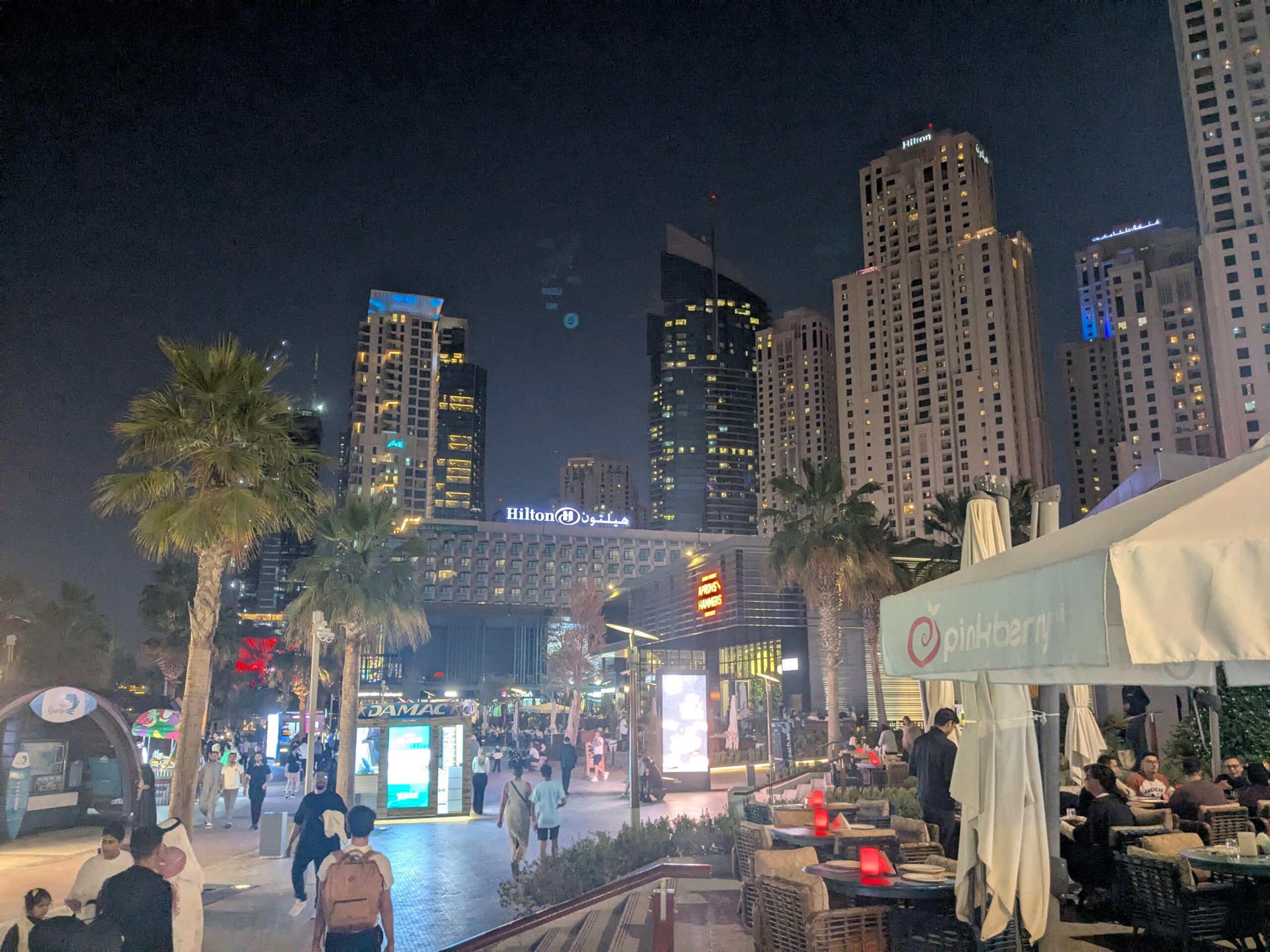
There is a lot of coverage on Dubai and the United Arab Emirates these days given the Iran War. Although I am trying to moderate my news intake, I read Janan Ganesh’s “We’ll always have Dubai” and Richard Florida’s “Could this be end of Dubai?” and have some thoughts after the jump.
Ganesh writes that a multipolar world needs a melting pot. The foreign-born population constitutes 90% of the population, the absorption of foreigners is part of the business plan–in contrast to increasingly hostile rhetoric around immigration elsewhere. Dubai is at the center of human activity, with the majority of the world’s population less than a 10-hour flight away. It’s the shallowness and sterility that gives the place its edge over Istanbul or other wanna-be global meeting points. No one has to adapt. That’s the whole point.
Florida takes a somewhat less sanguine view. He sees this shallowness as Dubai’s Achilles heel. No one is attached to the place. All it takes is a crisis and you see how the rootless race to the airports of neighboring emirates in search of private jet out. Cities have traditionally conveyed a sense of identity and belonging to its inhabitants. The lack thereof in Dubai (and other clones) is its fatal flaw. The “geography of nowhere” (Kunstler) offers convenience when things are good. But when the going gets tough, hypermobile inhabitants rush for the exit.
I find depictions of Dubai as a cosmopolitan 90%-foreigner city state misleading. In fact, it’s a highly stratified three-partite society with privileged citizens, internationally mobile “expats” and largely disenfranchised (politically and/or economically) labor migrants primarily from South Asia. The latter is not the group we usually have in mind when we think about Dubai residents, but constitutes more than half of the city state’s population. While there are also many skilled South Asian workers, most of the menial and low-skilled labor that makes this part of the world so “luxurious” is undertaken by migrants from India, Pakistan, Nepal and Bangladesh.
However, I think I side with Ganesh’s more nihilistic take overall. When Florida thinks that identity will win in the long term and that geographies of nowhere will not build the lasting social capital, he once again underestimates the power of capital. No better is this visible but in the stories of the same private jets evacuating people also bringing others back to Dubai so they can avoid having to pay taxes in other jurisdictions as they approach the maximum permissible stay there before becoming tax residents.
I have been in the region a few times in the past. Come to think of it, the first time I flew via Dubai en route to Bangkok was in 2001, when the city state had under one million inhabitants, less than a quarter of today’s figure. I returned properly in 2011 on a business trip, whose notes I jotted down on this blog a year or so later.
It was a fascinating journey that took me onto the Palm Island and on a private tour of DP World’s port. Here, according to my notes, executives shirked my questions about the Strait of Hormuz, apparently a little allergic against critical undertones just one year after a massive real estate crisis that shook the foundations of Dubai and asserted Abu Dhabi’s leadership in the Emirates. That same trip took me to Abu Dhabi, Qatar and Beirut, and proved a short but wonderful primer in the region’s economics and current affairs.
My wife and I came again for a short stopover to Qatar in 2017. It was a period of geopolitical turmoil, too, when Saudi Arabia and the UAE closed their airspace to Qatar Airways, forcing our plane to take a short detour via Iran to land safely in Doha. We stayed for one night and visited the beautiful Museum of Islamic Art. The trip was a reminder of the skewed demographics here, as well as the lopsided business case the Emirates and Qatar want to present to the world. These are feudal authoritarian regimes built on massive hydrocarbon resources. The shallowness that these places represent has to be read alongside this repressive authoritarianism. People will not care as long as there is money to be made or sheltered here.
The last time I went to Dubai was on a short family visit last year. What was striking this time was the way technological progress has been integrated into these exploitative and racialized labor relations. Now, the process of “downsourcing” via delivery apps was almost complete and a ubiquitous cohort of South Asian delivery drivers had become an indispensable feature of the new Gulf.
Does the current war represent a material threat to this model? It depends on the underlying mobility of both expats and labor migrants, and readily available alternatives. If things are looking bad in the Gulf, the world economy is likely also on the hook for serious volatility and a heightened risk of stagflation. This is not the best environment in which to contemplate moving. Like it or not, the Gulf is systemically important, and most probably here to stay. The way it will look here in a few years will tell us a lot about the state of the world beyond the desert sand.

